
By Erika Tally, Via Community News Service, a University of Vermont journalism internship
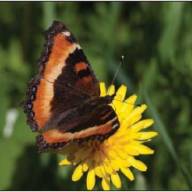
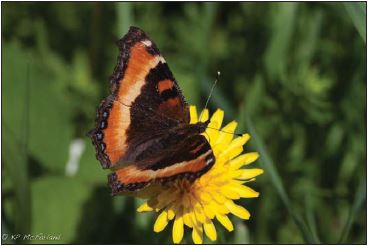
Milbert’s tortoiseshell is an early spring butterfly whose Northeast population has declined over 96% in the past 20 years. Photo courtesy Kent McFarland/Vermont Center for Ecostudies

A dozen naturalists looked on as the light swish of a butterfly net cut through the misty July air, snaring a darting white speck. A quick transfer to a specimen jar revealed that their find — a small white moth — was not one of their intended targets: butterflies.
“Moths look like they have anxiety when they’re flying around; butterflies look like they have a plan,” said Dana Williams, the community science coordinator for the Vermont Center for Ecostudies, before releasing the insect.
The group was taking part in the Greensboro Area Butterfly Blitz, one of the seven surveying events organized by the ecostudies center this summer. The scientists are teaming up with citizen naturalists to collect data over a period of five years for the state’s 2nd Vermont Butterfly Atlas, which will map butterfly species and their health across the state. The last atlas was published in 2007.
“We’re trying to go out and collect as many butterflies as we can, or records of butterflies,” said Williams, who led the Greensboro blitz.
Each atlas is created using data gathered over a five-year-period, with the last collection period occurring between 2002 and 2007. The ecostudies center believes it may be the first state in the country to undertake the creation of a second butterfly atlas.
Volunteers use a field guide to identify an insect. Photo by Erika Tally
During each “blitz,” volunteers and scientists survey one of the 184 “priority blocks” across the state. In each of these 9-square-mile plots, the group searches for butterflies, often seeking out their favorite spots, such as patches of milkweed.
Once a butterfly has been spotted, the race is on to identify the species before it takes flight. Bug nets, detailed field guides and even cell phones are used by participants in the field to get a better look at the insect. Once the species has been identified, they are released.
The data collected is just a snapshot in time but reveals a lot about each species, said Kent McFarland, co-founder of the ecostudies center and project director for the butterfly atlas. Each blitz collects information that can be used to analyze how populations, habitat ranges, lifespan, and seasonality have changed for each species since the last atlas.
The project is run in partnership with the Vermont Fish and Wildlife Department, which uses the data collected in Vermont’s Wildlife Action Plan, a blueprint for future conservation efforts by the state.
McFarland said the atlas will help Vermont’s conservation efforts since a species can’t be included in the plan without data detailing its condition.
“Are there as many monarchs as there used to be 20 years ago? Have Canadian tiger swallowtails changed over the two five-year periods? Those are some of the different things we can look at,” he said.
Volunteers are also key to the project, McFarland said, estimating that they help cut the data collection time in half.
“I think now, 20 years later, we really do have a great butterfly-watching and butterfly-conscious community in Vermont. We’re blessed to have that, all those people that really want to help do something like this butterfly atlas,” he said.
Volunteers at the Greensboro blitz embodied that sentiment on that chilly July day, when butterflies were unlikely to be active. By the end of the blitz, the final butterfly tally was still 0, which Williams attributed to the insects preferring temperatures between 65 and 85 degrees.
Yet, Williams didn’t see the day as a complete loss, saying that participating in the count at all is valuable in itself. The collaboration helps people better understand the process of science, she said, and giving volunteers the opportunity to be more involved fosters a greater sense of environmental stewardship.
“It’s actually the people who live here who were on the ground collecting the data to make the management plans for their own state, for their own community,” she said.