
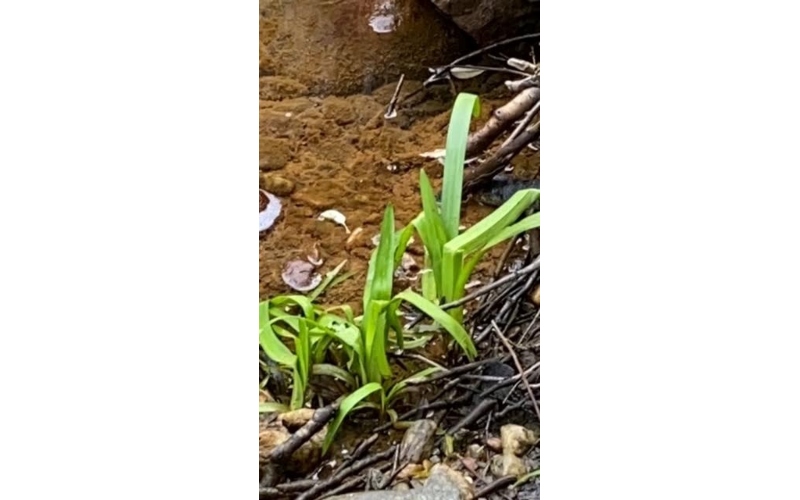
A Mad River Watch volunteer spotted a new plant near the Warren Covered Bridge while performing her regular inspection of the site as part of Friends of the Mad River's River Watch program. She brought that plant to the office where it was identified as the American bur-reed, a plant with the capability of stabilizing streambanks.

“Beyond all the hard data they collect, our volunteers are also responsible for reporting interesting or unusual observations, as they return to their sites week after week. These observations matter,” Rohan Press, watershed engagement coordinator for Friends of the Mad explained.
"Our volunteer Julie Westervelt, who monitors the Warren Covered Bridge, photographed a strange, new plant that she brought to my office to show me. It turned out to be the American bur-reed, and learning about this plant has been one of the most interesting and surprising detours of the season so far.”
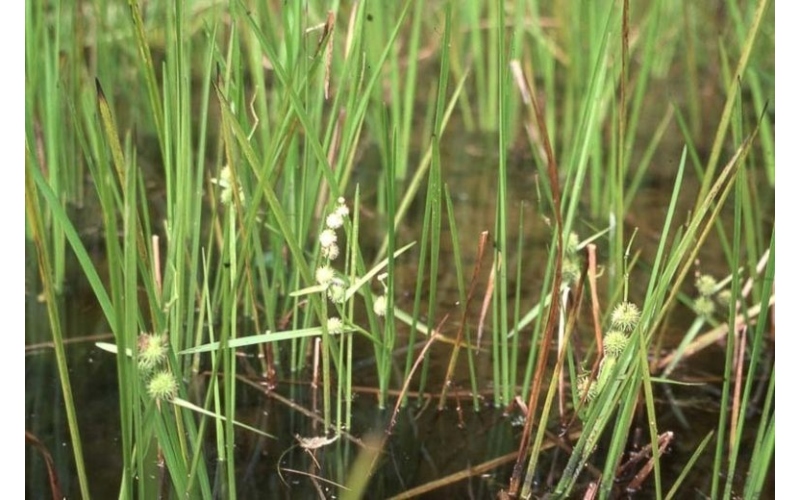
The American bur-reed (Sparganium americanum), distributed throughout the eastern and southern United States (and southeastern Canada) is a perennial, grass-like plant, with stiff, sword-like leaves that grows in shallow, marshy environments. It prefers peaty to sandy soils, which are more commonly found either around lakeshores or slow-moving streams; it is also occasionally seen as floating vegetation in boggy lakes. The bur-reed produces a cluster of tiny green flowers which become burr-like, uniquely spherical seed heads later in the season. The seeds within are a favorite food of many migratory waterfowl and the entire plant is also a preferred food source for muskrat.
Like Japanese knotweed, bur-reed can propagate by rhizome, as well as by seed—but unlike knotweed, its deep roots stabilize riverbanks and help to mitigate erosion, while also providing habitat and cover for nesting birds.
"This makes the bur-reed an important wetland species to keep an eye on for our conservation efforts. But the most remarkable thing about bur-reed is its capacity to uptake nitrogen and phosphorus from the soil in more efficient ways than many other comparable plants. In a paper by the State University of New York at Binghamton, scientists showed that bur-reed accrued more aboveground biomass and lower belowground biomass of nitrogen and phosphorus than other wetland plant species. The study also showed that American bur-reed had the highest concentration of nitrogen and phosphorus in aboveground tissue compared to the other species in the study," Press said.
Nitrogen and phosphorus, which come primarily from agricultural runoff (fertilizer and animal waste) are two of the primary water pollutants throughout the world. They are often considered “proxies” for water pollution in general. Left unchecked, these chemicals are ultimately responsible for the toxic algae blooms occurring in Lake Champlain.
Bur-reed can provide a crucial watershed function: removing toxins from the water at a high rate, and at the same time of year that those toxins are being produced in their highest quantities.
As Michelle Krieg, Friends of the Mad River restoration nursery coordinator, clarified, all wetland species, including the bur-reed serve this ecological function to an extent; it just so happens that bur-reed is especially efficient at this process. “Wetland species (and wetlands in general!) are excellent at filtering and cleaning water for a variety of reasons,” she explained. “Wetland vegetation serves as a physical filter, slowing down water and filtering out pollutants and debris. Mud also has a high CEC (Cation Exchange Capacity), meaning it holds onto a lot of positively charged ions and nutrients, which directly bind to negatively charged ions like phosphate. Wetland vegetation, including sedges (like American bur-reed), rushes, and aquatic and emergent herbs are also often highly efficient at nutrient uptake.”
“In general,” Krieg continued, “I love the idea of incorporating more herbs, graminoids, and direct seed mixes into our restoration efforts, since their benefits are more varied and often support the ecological succession of highly degraded sites, such as agricultural fields. I’ve been told that the reason a lot of restoration projects in Vermont haven't planted these species is because funding support has not yet caught up with the need for these types of plants, but that is also changing as people become more aware of their benefits.”
“This is just one example of how a simple observation by a Mad River Watch volunteer can spark a conversation with dramatic effect for our thinking about restoration work in the Mad River Valley and beyond,” Press pointed out. “For all their work, I’d like to once again extend a special thanks to everyone involved in the Mad River Watch program for their commitment and curiosity; their work is at the crucial nexus point where science, restoration, and education all come together.”
This weekend marked the final week of Mad River Watch water quality sampling, the annual program facilitated by Friends of the Mad River. This year’s team of 28 volunteers has been going out every two weeks since early summer to monitor water pollution, water temperature, and water pH, from headwaters to mouth, along the Mad River and its tributaries. Their work contributes to an archive of data that is one of the most extensive in the country. “This year, river data was fairly consistent with prior years, with no major or alarming spikes of pollution or temperature,” Press said. “In general, the Mad River remains one of the cleanest and coldest watersheds in the state, although it is still subject to dangerous levels of pollution from agricultural runoff after a rainstorm.”
American bur-reed, photo by Julie Westervelt
Another photo of bur-reed, photo by Mary Gillham