
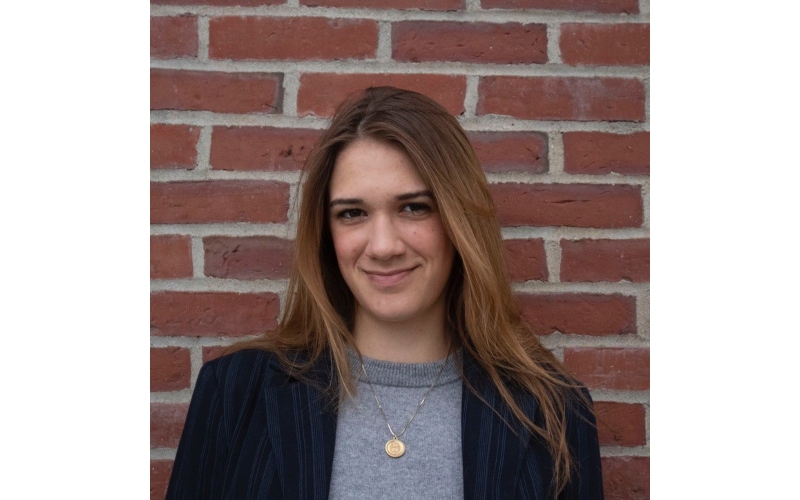
For Warren native Charlotte Mays the Vermont State House is more than a workplace. It’s a familiar hallway, a place of chance conversations and a training ground for the kind of public service she hopes to continue after graduation.

Mays, a senior studying political science and public policy at the University of Vermont, is spending this legislative session working as an intern for state Rep. Dara Torre, D-Moretown. The internship is part of a UVM program that places upper-level students inside the State House to learn the mechanics of government.
“This is my first year working with Dara, but this is my second year in this program through UVM,” Mays said. “Last year I worked for Representative Lisa Hango.”
The program itself is relatively young but popular among students interested in public policy. It is run by UVM professor Liz Raddock, Warren, who selects roughly 20 to 30 juniors and seniors each year to participate.
Participants are matched with legislators who request interns, then spend the legislative session splitting time between classwork and work in the State House.
“Liz matches us with the legislators who have notified her that they’re interested or would like an intern,” Mays said. Students attend class once a week while also committing to regular hours at the State House and completing additional assignments throughout the semester.
Each intern tracks a policy topic of interest over the course of the year and produces a final report on it. Students also submit weekly schedules and reflections while studying the broader mechanics of government.
“We review a lot of basic information about the democratic process,” Mays said. “And we have speakers come into class from time to time from the State House – the attorney general, the state’s attorney – people who can talk more indepth about the inner workings.”
The internship runs from winter through the end of the spring semester, and while students are only required to work at the State House at least one day a week, most end up spending far more time following legislation and watching committee hearings online.
Mays says the structure allows students to see far more than just their own legislator’s work.
“It’s really about understanding not specifically just your legislator, but how the state of Vermont runs,” she said.
A LONG RELATIONSHIP
For Mays, the experience builds on years of involvement in state government.
She first stepped inside the State House as a high school page – a role that sparked a lasting interest in politics.
“I was a page, and ever since being a page I really loved being in the State House,” she said.
That early exposure turned into a pattern of returning to Montpelier again and again. This is her sixth time working inside the building since 2017.
“The State House feels like another home to me at this point,” Mays said. “I really love being in there.”
Part of the appeal, she said, is the close-knit nature of Vermont politics. Compared with larger states, the environment is remarkably informal.
“You can just run into people in the hallway,” she said. “Some days you accidentally run into Gov. Phil Scott and have a ‘Hi, how are you?’ conversation. That’s super awesome and special.”
Last Mays worked for the House Republican caucus, an experience that gave her a broader perspective on the political process.
The role brought unusual opportunities for an intern, including the chance to sit in on meetings involving Gov. Scott.
“It was an amazing opportunity,” she said. “We got invited into some things that not all the other interns got invited to.”
Despite working closely with Republican lawmakers last year and a Democratic legislator this year, Mays says she tries to approach the job without partisan assumptions.
“I always express to other people who are interested in this to go into it with as much openness as possible,” she said. “When you pick a partisan side too early, it kind of shuts off opportunities you didn’t even know existed.”
“At the end of the day,” she added, “I’m not there for personal politics. I’m just trying to help.”
TRACKING LEGISLATION
Much of Mays’ day-to-day work revolves around monitoring legislation.
She maintains a detailed spreadsheet tracking dozens of bills that Torre has sponsored, co-sponsored or expressed interest in. Each week she updates the document with the bill’s status, committee activity, and any amendments. The spreadsheet also includes notes about changes to legislation and research on similar laws in other states.
While interns are free to attend committee meetings related to their bills, the schedule can vary widely depending on lawmakers’ schedules.
“Some days you have a super strict schedule,” Mays said. “Other days your bills aren’t being discussed, so you have more flexibility to walk around and see other things.”
When that happens, she often sits in on other committees – particularly education committees this year, as lawmakers grapple with reforms to the state’s complicated school funding system.
WATCHING A DIFFICULT POLICY DEBATE
Education funding has become one of the most complex issues facing lawmakers this year. Proposals to restructure school districts, manage rising property taxes and address declining student enrollment have sparked intense debate.
Mays, who attended schools in the Mad River Valley, says the problem has no simple solution.
“I think it’s an extremely complex decision,” she said. “Regardless of what decision is going to be made, there’s going to be an issue.”
In her view, Vermont’s small size and rural geography complicate efforts to consolidate school districts.
“There’s never going to be perfect math,” she said. “You can get as close to perfect as possible, but accessibility and the distance between towns are always going to be challenges.”
While she believes some consolidation may be necessary, she also worries about losing the local focus that smaller districts provide.
“One of the cool things about Vermont is teachers can pay such specific attention to kids’ educational needs,” Mays said.
She suspects that whatever reforms lawmakers pass this year will only be the beginning of a longer process.
“Whatever the outcome of this year is, it’s going to need to be fixed again,” she said. “This is not going to be a one-and-done solution.”
A CALL FOR UDERSTANDING
Watching the legislative process up close has shaped Mays’ perspective on public criticism of lawmakers.
She says many people underestimate how demanding the job can be.
“These people are always working — morning to night,” she said. “I’m exhausted from some of the work I do. I can’t imagine doing it every single day for six months.”
That experience has left her hoping for more patience from the public.
“Democracy works when everyone kind of gets along and gives people grace. I think there should be a little more grace given,” she said.
Mays credits local journalism with helping her understand the state issues. In a political environment where information often spreads quickly through social media, she said local reporting remains one of the most reliable ways to stay informed about state government. She regularly reads outlets such as Seven Days, The Valley Reporter and VTDigger to track policy debates and legislative developments. “Your best access to information is local media,” Mays said. She said she tries to follow multiple sources and encourages others interested in politics to do the same. Too many people, she added, rely on incomplete information online rather than seeking out reporting that explains the details of legislation and the decisions being made in Montpelier.
LOOKINF AHEAD
Mays graduates this spring, though she says her long-term plans are still uncertain. She has considered applying for a committee assistant position at the State House but may also look outside Vermont. Rising housing costs and property taxes have made staying in the state difficult for many young people, she said.
Even if her career takes her elsewhere, she expects to stay involved in politics and public policy.
For now, she’s focused on finishing the internship and making the most of the experience – including the everyday conversations that make Vermont politics feel personal.
“I really try to have as many conversations with whoever is in the hallway,” she said. “You just never know who you’re going to meet.”