
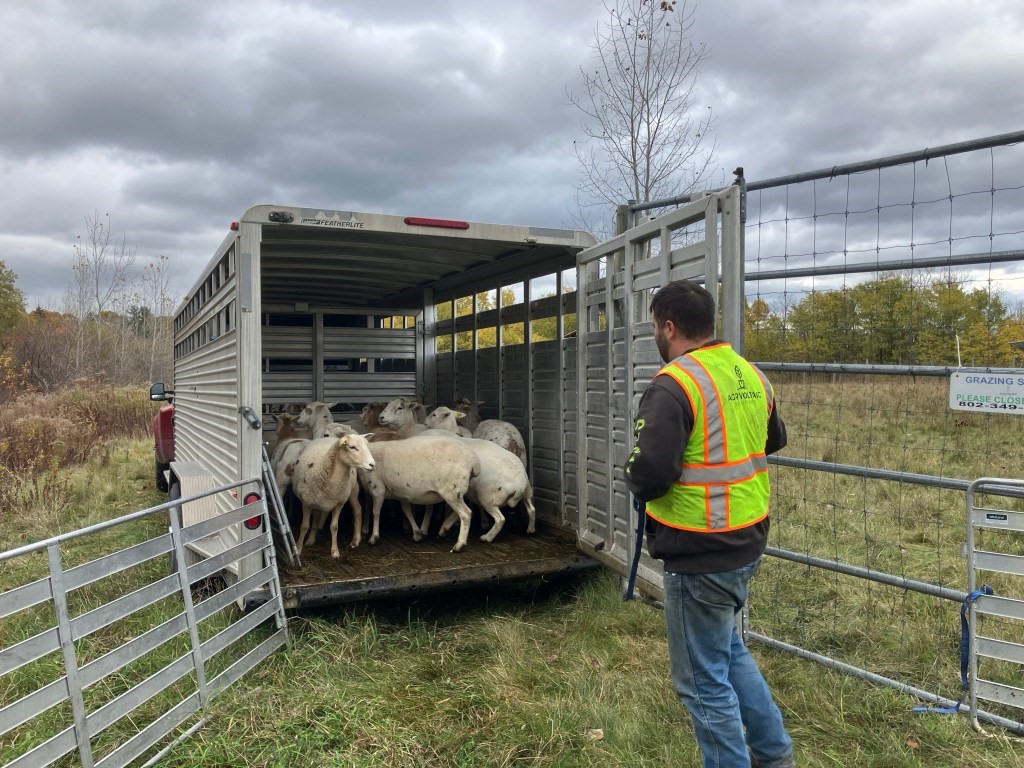
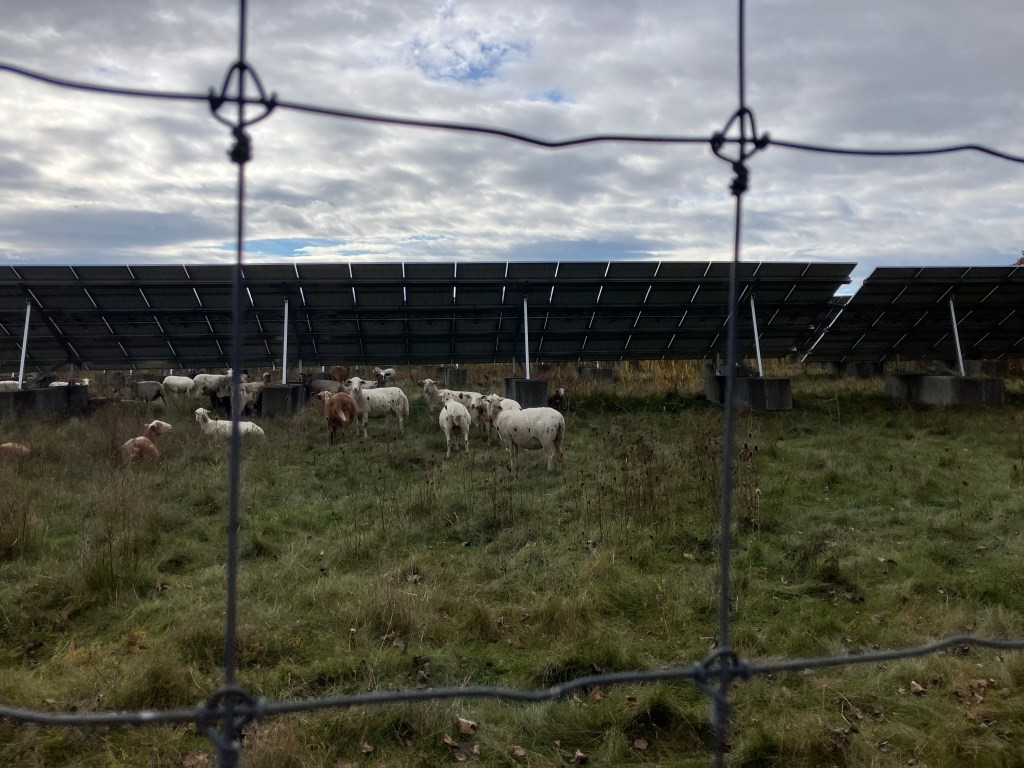
Cutline: Sheep on a solar farm in Colchester on October 23, 2025. Photo by Maeve Fairfax
Via Community News Service, a University of Vermont journalism internship, in partnership with Vermont Public
As solar grows, so does Vermont’s capacity for agrivoltaics – the dual use of land on solar farms for agriculture. On solar farms, the ground beneath the solar panels is often planted with turf grass and left alone. But some Vermonters are experimenting with productive ways to use that land: grazing livestock, growing crops, and creating habitat for threatened pollinators and birds.
Solar makes up about 16% of the energy Vermont generates, and that number has been growing for over a decade. As solar grows, so does Vermont’s capacity for agrivoltaics – the dual use of land on solar farms for agriculture.
Lewis Fox is a sheep farmer in Leicester, Vermont. With his wife, Niko Kochendoerfer, he runs a business called Agrivoltaic Solutions. They are hired by solar companies to manage the vegetation on solar farms. “We’re in charge of keeping the vegetation within certain limits, and the sheep are the tools that we use to do it,” Fox said.
Fox said that sheep are ready-made for solar farms. “They’re pretty short stature, so they can really fit into nooks and crannies,” he said. “They’re also not really interested in chewing on wires or jumping on panels.” The panels also provide sheep with protection from the elements and shade, which means that the sheep don’t need to drink as much water on hot days.
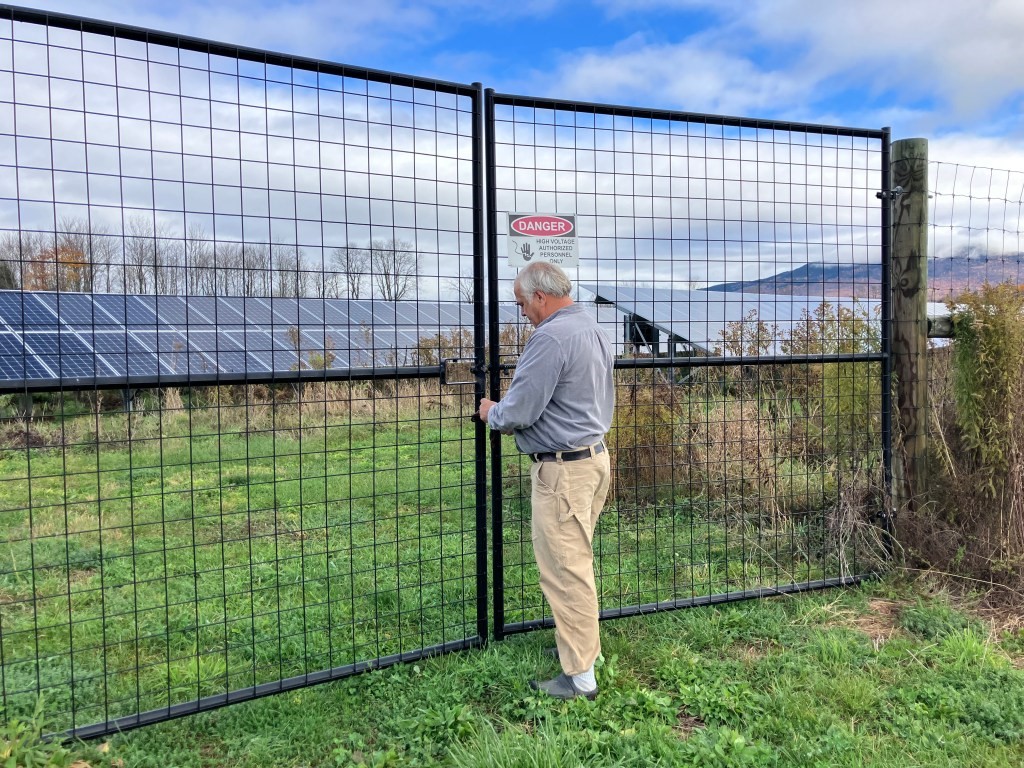
Cutline: Mike Kiernan, co-founder of Bee the Change, opens the gate to a solar site in Stowe on October 21, 2025. Photo by Maeve Fairfax
Fox and Kochendoerfer work with farmers from Buffalo, New York, to Bangor, Maine, helping them learn the ropes of solar grazing. Fox is also a founding member of the American Solar Grazing Association, an organization that promotes solar grazing and provides educational materials for farmers who want to get into it.
In the winter, when there is no grazing to be done, Fox and Kochendoerfer breed the sheep and sell grass-fed lamb. Fox said that the additional revenue they earn from agrivoltaics is a huge help financially. “For us as livestock producers, being able to use the animals in another way is very significant in terms of farm viability,” he said.
Solar grazing has exploded in recent years. There are currently about 130,000 acres of solar arrays in the United States grazed by sheep. “We think it’s got a bright future,” Fox said.
Sheep aren’t the only animals that can find food on a solar farm.
The Weybridge-based nonprofit Bee the Change is turning solar fields into habitat for bees and other pollinators. Since 2015, they’ve created habitat on 30 solar sites.
Mike Kiernan is a co-founder of Bee the Change. He said one of the organization’s main goals is to support Vermont’s native bees, many of which are threatened by loss of habitat, disease or pesticides.
Kiernan said that although some invasive plant species can be helpful to pollinators, the team at Bee the Change tries to plant native species at these sites. “Our goal is to get the highest percentage possible of native plants, because they have the longest relationship with these species,” Kiernan said.
And their efforts are working.
Through careful monitoring, the leaders at Bee the Change have seen pollinator populations on their sites increase dramatically in both number and diversity.
Supporting pollinators also helps support the plants they pollinate, which helps people, too. “We’re all actually connected, and our survival is connected,” said Kiernan. “And when people see a habitat that is enriched with pollinators, they are appreciative.”
Encore Renewable Energy, a Vermont-based B Corp, has hired both Kiernan and Fox to manage the vegetation on its solar sites. The company specializes in community-scale solar projects.
Chad Farrell is the co-CEO of Encore Renewable Energy. He said the company prioritizes using agrivoltaics because it’s good for local economies and good for the environment.
Solar grazing is often cheaper than mowing, and it cuts down on emissions because mowers, which run on fossil fuels, are not needed as often.
Planting native plants to build pollinator habitat can increase the soil’s potential to store carbon by 65%. It’s also good for the soil’s overall health — potentially paving the way for future agriculture on the land. “At the end of the useful life of the project, we’re actually able to return that land in a better condition than what we found,” Farrell said.
Some Vermonters don’t like to see agricultural land repurposed for energy production, but agrivoltaics can help alleviate this tension. “Everybody loves driving by one of our projects and seeing a bunch of sheep out there doing their thing,” Farrell said.
Lewis Fox, the sheep farmer, agrees.
“It’s often difficult for people to see solar being built on ag land, for various reasons, and I think you could argue the merits either way,” he said. “But we can help bridge the gap in that. What we’re able to do is have solar production coexist with agriculture. And it’s not just window dressing. It’s real agriculture.”