
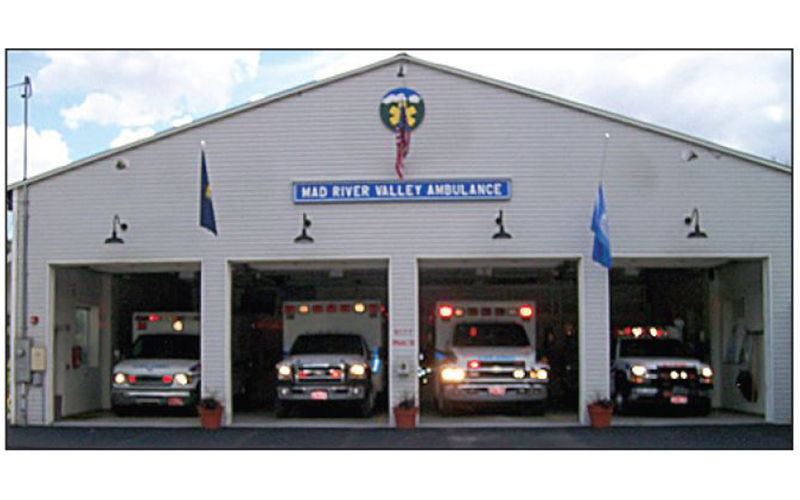
The Mad River Valley Ambulance Service (MRVAS) is facing operational changes to its dispatch system that will alter how emergency medical calls are dispatched in The Valley and increase costs for its member towns this year.

The change stems from the pending loss of a key piece of telecommunications infrastructure that currently connects the volunteer ambulance service directly to Vermont’s 911 system, according to Mark Giometti, treasurer of the Mad River Valley Ambulance Service.
In early December, Waitsfield and Champlain Valley Telecom (WCVT) notified MRVAS that the vendor supporting its “firebar” system – the telephone bridge that allows 911 to connect directly to local ambulance dispatchers – would stop providing software support and maintenance as of December 31, 2025. Because of liability concerns associated with hosting unsupported software, Waitsfield Telecom informed MRVAS the system would be taken offline at the end of the year.
“The loss of the firebar would dramatically impair, if not prevent, MRVAS from providing EMS services to our Valley coverage area,” Giometti said in a memo to town officials dated January 16.
To allow time for a transition, WCVT agreed to continue hosting the unsupported system through January 31, 2026. After that date, MRVAS will no longer have a direct link to the 911 network unless an alternative is in place.
MRVAS explored replacing the aging system with a modern voice-over-internet-protocol platform, but that option was ruled out due to the state’s long-term plan to consolidate independent EMS dispatch services into regional centers within the next five years.
“Any capital investment in developing in-house technology would then become immediately obsolete,” Giometti said.
To avoid that issue, MRVAS joined a pilot program with Capital Dispatch, the company that already handles 911 fire department calls in the Mad River Valley. Under the hybrid system, Capital Dispatch will answer all 911 calls and simultaneously alert MRVAS responding personnel while contacting the on-duty MRVAS dispatcher.
Giometti said the arrangement preserves the institutional knowledge of local dispatchers while ensuring reliable 911 access through a provider with modern technology and backup systems capable of operating during natural disasters. He added that shared fire and EMS dispatch is expected to streamline emergency response and improve public safety.
Capital Dispatch will cover the cost of the new system through June 30, 2026. After that, Valley towns would be billed for EMS dispatch services in addition to their existing fire dispatch costs. The estimated annual incremental costs above current fire dispatch billing total $72,125 across the four towns served by MRVAS.
Under the estimates provided, Fayston would see an additional $9,475 annually, Moretown $9,305, Waitsfield $24,125 and Warren $29,220.
While moving to a third-party dispatch service will reduce MRVAS telephone expenses by about $22,000 per year, those savings will not offset broader financial pressures facing the organization.
Giometti said higher contracted training costs, ambulance maintenance expenses and new officer manager benefits are expected to significantly reduce MRVAS’s net ordinary income, defined as income before donations, interest and depreciation. Net ordinary income is projected to fall from $112,000 in 2025 to just $5,000 in 2026.
As a result, MRVAS will become increasingly reliant on donations to fund its capital reserve account. In 2026, the service projects that 81%, or $120,000, of capital reserve contributions will come from donations, including $42,000 from the four Valley towns.
Even with that level of support, MRVAS faces a growing capital funding gap. The organization ended 2025 with a $19,000 deficit, which is projected to grow to $249,000 over a 10-year planning horizon. Beginning in 2027, MRVAS estimates it will need an additional $25,000 per year from its member towns to maintain its current level of readiness.
Despite the challenges, Giometti emphasized the commitment of the service’s volunteers. MRVAS is one of only two all-volunteer ambulance squads remaining in Vermont. In 2025, volunteers responded to 564 calls and donated more than 32,000 hours covering shifts, responding to emergencies, maintaining certifications, and caring for ambulances.
You might also like