

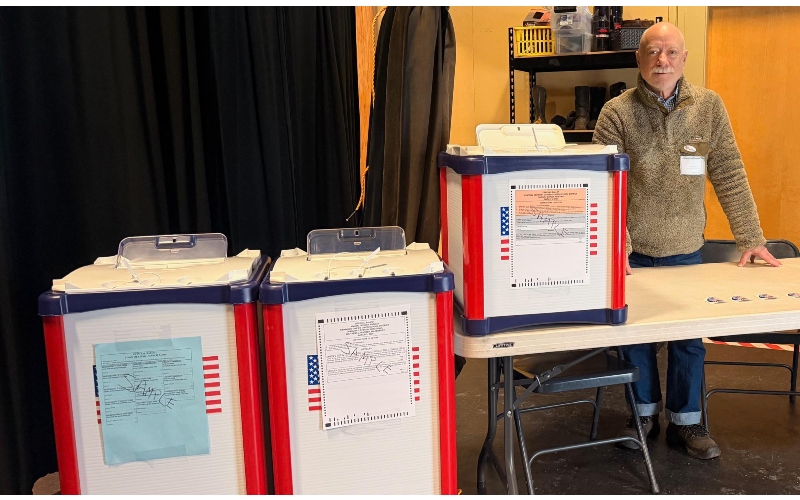
Warren Elementary School townspeople on Tuesday night subjected their proposed $5.4 million municipal budget to nearly an hour of pointed, line-by-line scrutiny, pressing the select board on spending increases, capital reserves and surplus funds before ultimately approving the plan.

“This is not New York City. These are volunteers,” resident Randy Taplin said to applause after several residents sharply questioned the board’s decisions and presentation of the numbers.
The March 3 Town Meeting opened with a legislative update from Rep. Candice White, D-Waitsfield, who recognized Dan Raddock for 17 years of service on the Warren Planning Commission and outlined major issues under consideration in Montpelier.
White said lawmakers are in the second stage of Act 73, the education transformation law, focusing on teacher preparation and special education in search of cost savings. Governor Phil Scott has said he will not sign a final bill without a district consolidation map, she said.
On health care, White highlighted H.266, which caps hospital drug costs tied to the federal 340B program. She said the measure has generated an estimated $230 million in savings statewide and helped ease pressure on teachers’ health insurance premiums. Vermont is also considering joining ArrayRx through H.577, a multi-state prescription drug discount program that could bring further savings, she said.
White, who serves on the House Transportation Committee, warned that rising construction costs and declining gas tax revenue are squeezing the state’s transportation budget. Electric vehicles do not contribute to the gas tax, she noted, and a new road usage fee structure is expected in 2027 to ensure all drivers contribute. Vermont Agency of Transportation officials have already cut 30 positions, and further reductions are anticipated in fiscal year 2027, she said.
The longest debate of the evening centered on Article 1, a $5,411,053 town budget that ultimately passed 92-21 after two amendments.
Former Sugarbush Resort president and town resident Win Smith cited a 7.6% overall increase and questioned what he described as a roughly $1.2 million discrepancy between budgeted and actual 2025 spending shown in the town report. He also asked whether surplus funds could be used to pay down debt on the town garage.
Select board member Harvey Blake said the difference was largely a matter of presentation, explaining that capital expenditures are tracked separately, and that actual spending was closer to $4.4 million when those accounts are included. Approximately $300,000 in operating surplus remains in the general fund and is used to buy down the tax rate, board members said.
Former board member and chair Bob Ackland pressed for detail on a $100,000 line for building repairs and maintenance, while Hardy Merrill compared Warren’s town report unfavorably to Waitsfield’s and moved to postpone the vote for further review. The motion failed to secure the required two-thirds majority in a show of hands vote.
An amendment by Marie Schmukal restored funding for the Warren Arts Committee from $2,500 to $5,000, passing by a large majority. A second amendment by Ackland to cut the repairs and maintenance line in half failed by a single vote, 53-52.
Select board chair Devin Klein Corrigan acknowledged the board “sometimes makes mistakes” and encouraged residents to engage earlier in the budget process. The amended budget then passed.
Voters approved Article 3, appropriating $15,150 for the Vermont Route 100 Active Transportation Corridor, a partnership effort with Waitsfield to complete an alternative transportation corridor north through Waitsfield and Moretown and Middlesex.
Misha Golfman director of the Mad River Path Association said roughly three miles of path remain unbuilt between Warren and Waitsfield. The proposed funding would support a 20-hour-per-week project coordinator to leverage grants and manage implementation.
Warren Town Historian Shannon Dunfey Konvicka called the path a “30-year dream” and said the investment could unlock millions in outside funding. Speaking of biking with her family along Route 100, she said, “This isn’t a cost. It’s the best investment this town can make.” The voice vote drew only a handful of “no” votes.
Article 4, designating the Town Hall as the permanent home of the Warren Public Library, also passed after brief discussion. Resident Ellen Strauss said she wanted to ensure the building remains available for broader community use. Klein Corrigan said the vote formalizes the library’s location while preserving Town Hall’s community functions. One resident indicated she would seek to revisit the question next year.
Under Article 7, voters approved $25,000 for the Warren Parent-Teacher Organization, formalizing a process for annual review of the funding. PTO vice president Jamie Kimon outlined programs supported by the appropriation, including a winter ski and snowboard program at Sugarbush, an outdoor ECO classroom, an artist-in-residence program and community events. “This funding is very important to us,” she said.
During open floor, residents praised outgoing Moderator Josie Klein and discussed the future need for a successor. In response to questions, Town Clerk Brent Adams said names of births and deaths are no longer published in the town report due to confidentiality guidance. A longtime resident again raised concerns about a failing culvert header on Powderhound Road; Klein Corrigan said she would speak with the road foreman.
Warren voters enjoyed a late dinner at a community potluck following the meeting.
In Australian balloting, voters elected Macon Phillips to the Harwood Unified Union School District Board as a write-in, re-elected Klein Corrigan, Blake and Joel Taplin to the select board and elected Ken Scott to the select board.
(Citizen journalist Shannon Dunfey Konvica covered this meeting for The Valley Reporter.)