

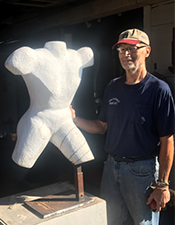
By Chris Curtis
John grew up on farm in upstate New York where hard physical work was the norm. He and his older brother were uber-competitive, who could run fastest, throw the stone the farthest. That early and constant competition, coupled with his farm work ethic led him to excel in athletics, being on the football and track team in high school and becoming a self-taught skier, ski racer and eventually professional ski racer competing on the national level. He took his ski racing experience further, becoming a race coach at the Mount Mansfield Ski School. He was a ski instructor and Nastar Ski Race race setter in Taos, New Mexico in 1973-74
In 1986, he competed in the arduous Vermont indoor rowing championship, placing third.
The passion for training and rowing brought him close to a former Mexican rowing champion and Olympian in Mazatlán. The old coach showed off John as “the old man” on the rower to younger more fit guys who could not match his performance.
He was an avid bicyclist, training to compete in century rides (100 miles) by riding the Appalachian Gap to Bristol, then back via the Lincoln Gap Road, both steep, cruel climbs.
Behind his house was a steep hill leading to what he called “The training ground of champions” where he trained and foraged for ramps. He liked to surf, although proximity to the ocean limited this participation.
John was a self-taught artist. Early on he painted mostly with acrylic, sometimes very thick impasto and even including objects on the surface. His freedom from traditional academic training allowed him to experiment widely with materials, techniques and styles.
He attended weekly figure drawings with Billy Brauer who helped him develop skills and confidence on paper. His soft touch figure drawings are a sharp contrast to his exploration in abstract “raw” shapes as he called them. His series of “Them” a combination of dark abstract figures and unmistakable humanness was a good example. When traveling or in Florida he took his drawing material with him and sought out drawing groups to join.
As a trained welder, he could manipulate steel with ease, often with clever workarounds when lacking the exact equipment he wanted. For metal, he found raw material in scrap yards; for stone, he hunted for good boulders.
In 1992 john wrote about his approach to sculpture in a manifesto titled “On Availabalism,” in which he explained his and many other sculptors’ approach to sculpture…use what you have. He used a collage to illustrate the point that if you start with some kind of art cut from a magazine and overlaid it on another piece of art, you have created super art. The raw input material for Availabalism is collectively called Obtainium.
Employing this philosophy, he created a series of breakthrough cardboard sculptures for an exhibit at Axel’s gallery in Waterbury that received high critical marks in the Seven Days review of the show.
In the 1970’s John exhibited his work at the Krystal Gallery in Warren. The owner, Hanni Saltzman gave him the name “Mr. Wonderful,” which stuck among friends for years until he upgraded it briefly to “Mr. Fabulous” then on to the eventual “Mr. Everything”
He named his Waitsfield studio “Action Central” and closed it promptly at 4 p.m. to go bike riding in the summer. In the winter Action Central would not open until the skiing was over, if at all.
He exhibited at West Branch Gallery in Stowe for many years with a solo show in 2010.
In recent years John wintered in warmer climes, including Mexico and Florida.