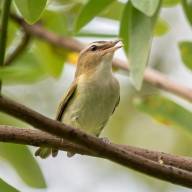
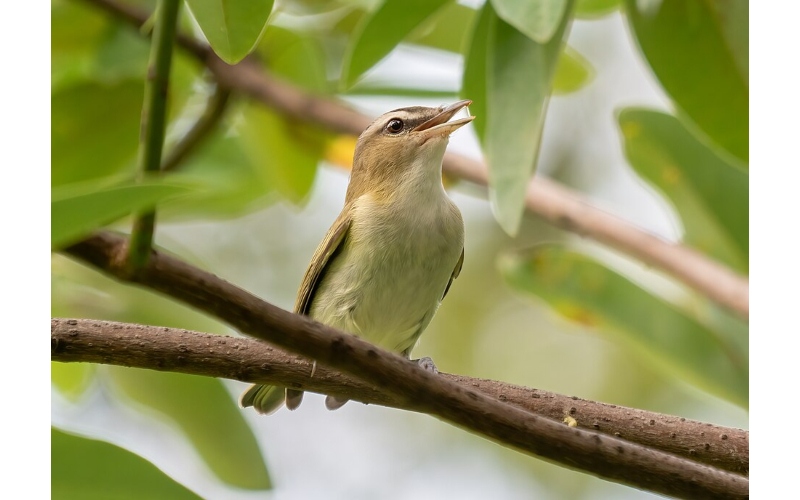
On July 19 and 20, Mad River Watch volunteers visited field sites to collect data and make environmental observations, contributing to decades of monitoring along the Mad River and its tributaries. Mad River Watch volunteers assess hard data like pH, conductivity (a proxy for sediment-loading and pollution), and water temperature. They also record observations about invasive species, erosion, weather, wildlife, and any other meaningful factors they notice while visiting their sites. This week’s article, part of an ongoing series, aims to highlight one of the bird species that has been observed over the course of the field season: the red-eyed vireo.

Volunteers Brooke Johnson (Meadow Road, Waitsfield) and Jenn Grant (Ward Access, Moretown) heard the red-eyed vireo (Vireo olivaceus) while spending time out in the river this year. A common bird across the eastern United States, where it breeds before heading to the South American tropics for the winter, the red-eyed vireo is famous for the frequency of its birdsong.
“Male vireos have been documented to repeat their song, which has something of a question-and-answer rhythm to it, upwards of 20,000 times in a single day,” explained Rohan Press, watershed engagement coordinator with Friends of the Mad River. “Nonetheless, though common to hear, they are less common to see. Vireos typically hide in the upper canopies of large, riparian, hardwood trees, where they forage for insects.”
Vireos, as with many other bird species, are reliant on a healthy riparian forest—which is the stretch of woodland immediately adjacent to a stream. The riparian zone offers a unique habitat, forage, and nesting sites for many such birds. “The vireo requires mature, riparian canopy species, like elm and cottonwood, because it only builds its nests in the crooks of especially large branches,” Press explained. “For this reason, a riparian forest generally needs to be about 50 feet wide, from stream bank to field edge, to be able to support the vireo. And the vireo is not alone in needing this kind of wide buffer. Some species, such as the Scarlet Tananger, actually require buffers that are at least 150 feet wide. In general, the wider the buffer, the greater diversity of bird life you can expect to see.”
“Many of our Mad River Watch sites have riparian buffers that only partially meet these optimal standards,” Press continued. “Some sites don’t have riparian buffers at all, only monocultures of invasive shrubs like Japanese knotweed. But it is encouraging to know that species like the vireo and cedar waxwing are still present in healthy numbers on the landscape, and it’s important that we manage and restore our riparian landscapes to keep it that way.”
Friends of the Mad River is working actively to help restore degraded riparian buffers through tree-planting and introduced species management projects throughout the Mad River Valley. Last week, the organization held an open house celebration for its new Restoration Nursery, at Lareau Farm, whose mission is to locally source and cultivate native, riparian plants that will be used in these future projects—perhaps someday providing habitat for birds like the red-eyed vireo. “At the end of the day, though,” Press reflected, “much of the impetus for that work comes from our volunteers, who provide the baseline field assessments we need to determine where these projects are most needful. And this is one of the reasons that the Mad River Watch program is so meaningful: not only for the long-term archive of data that it provides, but for these personal observations and interactions with birds and other wildlife that it elicits. That’s where restoration work really begins.”
A Japanese Knotweed colony along the Mad River. These knotweed monocultures do not offer sufficient bird habitat for species like the red-eyed vireo. Photo by Rohan Press.
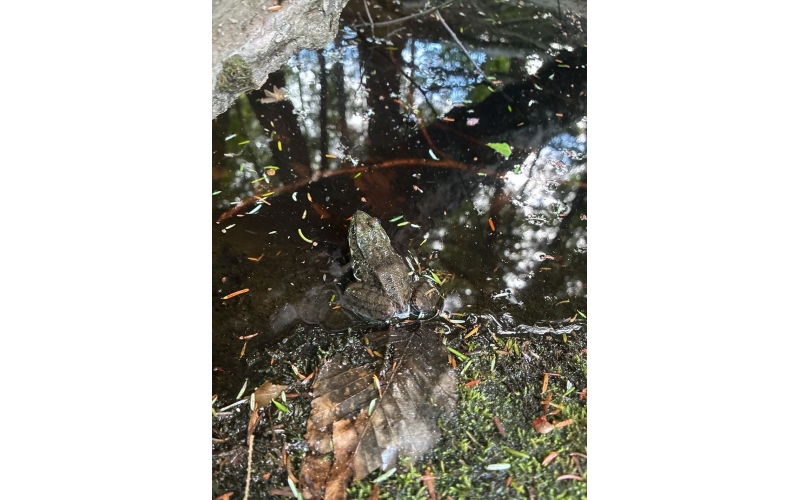
A wood frog spotted at Warren Falls. Photo by Emily Church.