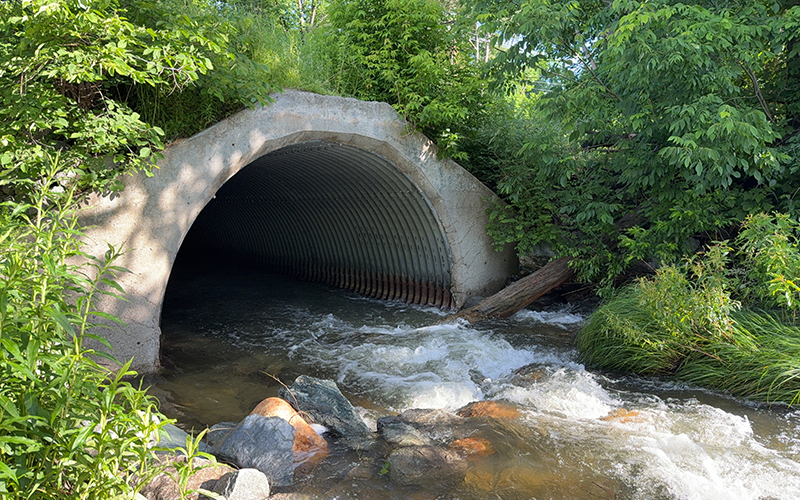
After four days of rain, Friday through Monday, Friends of the Mad River’s volunteers gathered data from field sites throughout The Valley, finding high flow levels and higher pollution levels. On June 21 and 22, teams of Mad River Watch volunteers visited field sites to collect important data and make careful environmental observations for the second time this summer. This article is part of an ongoing series that shares highlights from this field work as well as lessons learned from this year and the past 40 years of Friends of the Mad River’s Mad River Watch program.

STORM-LOADING
One of the most consistent and meaningful trends from across the long history of water quality sampling on the Mad River is the sediment and chemical “flush” seen following a rainstorm. This week, it rained intermittently on Friday, Saturday, Sunday, and Monday, with particularly high levels of rainfall on Saturday. A river’s flow, following such a rain event, is called a “freshet” flow, meaning that the flows are higher, more concentrated, and more polluted with runoff from the landscape.
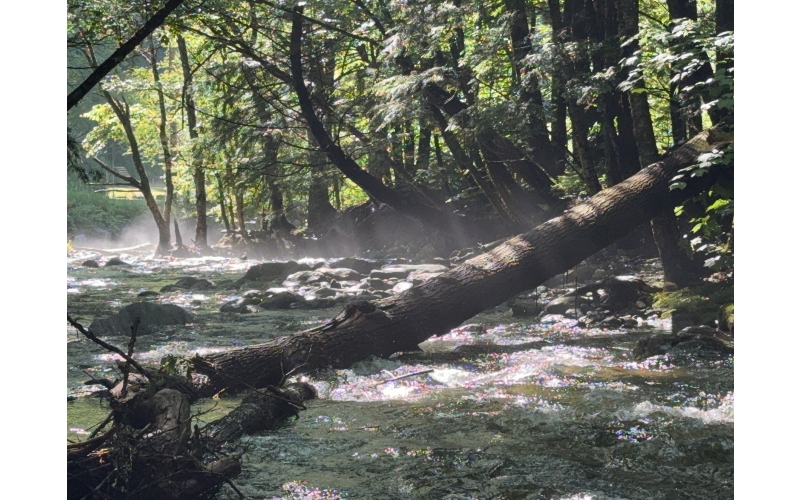
In the 24 hours after a rain event, observers can expect to see the most dangerous flow levels and the highest levels of pollution.
“I recommend not swimming or recreating in the river on the day after a storm, even if the weather, that following day, is warm and sunny,” remarked Rohan Press, watershed engagement coordinator with Friends of the Mad River. “Flows are fast, unpredictable, and potentially dangerous and the bacterial and chemical load in the river is at its highest during this period.”
PUBLIC CONCERN
Most of this nutrient-loading comes from agricultural sources (e.g. fertilizer and manure), which are more highly concentrated downstream in northern Waitsfield and Moretown, he added.
Of particular public concern during this “freshet” period is the bacteria Escherichia coli (abbreviated as E. coli) which is well-known for its potential to cause diarrhea, urinary tract infections, respiratory illness, and pneumonia. E. coli grows in the intestinal tract of warm-blooded animals, including domestic, agricultural mammals common across the state, like cows, sheep, and goats, whereupon it is transmitted to their fecal matter, and from there, swept up by stormwater into the river. Not all strains of E. coli are harmful to humans; in fact, many benign serotypes are naturally-occurring in the gut. Certain serotypes of the bacteria can have harmful effects and, more importantly, can indicate the co-presence of other pathogens in the water. Therefore, coliform bacteria (the class to which E. coli belongs) is often used as an indicator of overall water quality and sanitariness.
BEST PRACTICES
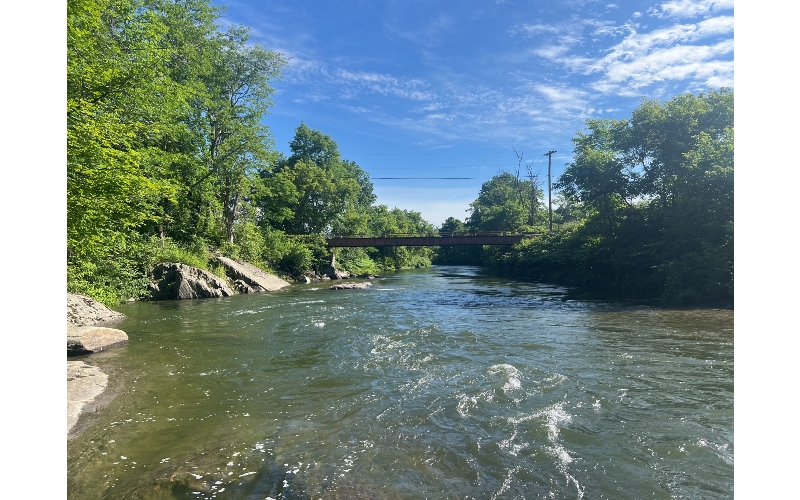
“We are often asked why Friends of the Mad River no longer monitors for E. coli,” Press said. “The primary reason is that the trend for E. coli levels in the Mad River is already quite well understood; continued monitoring would be unlikely to tell us anything new. We know that, basically, the only time we see dangerous levels of E. coli in the river is in that 24-hour period following a rain event—this is a consistent trend. There is nothing that continued monitoring for E. coli is likely to tell us that we don’t already know. The best practices are the intuitive ones: don’t swim after a storm or if the water looks unusually cloudy with mud or sediment.”
NOTES FROM THE FIELD
Heavy rains on Saturday and intermittently throughout Sunday morning showed up in volunteer observations. Trees fell at a monitoring site in Folsom Brook and there was a significant debris pile-up noticed at Chase Brook in Fayston. Volunteers noted evidence of erosion and deposition at nearly all field sites. Conductivity values were highest on Sunday morning, as high as 113 microsiemens per centimeter at Freeman (“Kids’”) Brook in Warren. Water temperatures ranged from a low of 54F at 9 a.m. at Bobbin Mill to a high of 60F at the Waitsfield Covered Bridge.