
Waitsfield voters unanimously approved a $2,874,507 municipal budget at Town Meeting this week and, after pointed debate, agreed to contribute $15,150 toward a part-time implementation coordinator for the Mad River Path, a proposal that drew concerns before passing by voice vote. The funding for the path position – shared with neighboring Warren and the Mad River Path Association – closely watched at Town Meeting, held at Waitsfield Elementary School. While the budget itself passed without dissent, the $15,150 allocation prompted discussion about timing, scope, and long-term costs before voters gave it tentative approval.

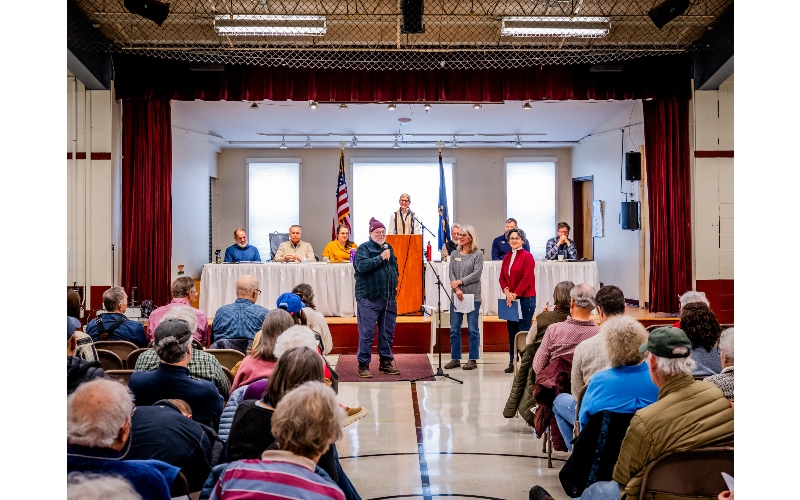
The March 3 Town Meeting drew a near-capacity crowd, with most chairs on the gym floor filled and bleachers nearly full. Residents gathered beginning at 9 a.m., with coffee, tea, and pastries from Twisted Halo available as a steady stream of voters cast Australian ballots.
ED FUNDING
State reps. Candice White, D-Waitsfield, and Dara Torre, D-Moretown, opened the meeting with a legislative update that quickly turned to education funding and reform.
Torre said financial limitations are a major hurdle in this year’s state budgeting process but said lawmakers were effective in containing educators’ health care costs.
White voiced support for Waitsfield adopting a 1% Local Option Tax and addressed education reform under Act 73, noting that Governor Phil Scott has said he will not sign a budget bill that does not include education reform.
Michael Hock criticized the governor’s approach, specifically his comments about recent education assessment results, and disparaging educators for what the governor and Agency of Education said were poor results. Hock said Scott is using extortion with the Legislature and public to push consolidation into five school districts without direct connection to performance or educational outcomes. He asked whether lawmakers could “call the governor’s bluff” and filibuster a budget vote. Town Meeting Moderator Kari Dolan reminded him to remain civil.
Select board member Fred Messer asked how much legislators anticipate education taxes will rise, saying he had heard projections of 10% to 12%. White responded that discussions are ongoing and that money has been set aside to buy down education taxes this year. She said she supports those buy-downs even if they create future fiscal pressure, adding that education taxes will continue to rise until structural issues are resolved.
 Photo by Lisa Loomis
BUDGET
The approved municipal budget totals $2,874,507, with $2,376,777 to be raised from property taxes. Select board member Chach Curtis presented a slide deck outlining capital needs and long-term planning. The town plans to deposit $900,000 into its Capital Reserve Fund for fiscal years 2026 and 2027 and draw $500,000 this year for expenditures.
Waitsfield is the only Mad River Valley town asking voters to approve a 1% Local Option Tax this year. As proposed, the tax would apply to rooms, meals, alcohol, retail and online sales and is projected to generate about $600,000 annually.
If the LOT passed, the select board recommended allocating 35% of the LOT revenue to the Bridge and Culvert Reserve Fund, 20% to the Paving Reserve Fund, and 15% each to the All Hazards Recovery Reserve Fund, the Waitsfield-Fayston Fire Department Building Reserve Fund and the Road Department Facilities Reserve Fund. The LOT did pass by a vote of 362-168.
Brian Voigt proposed amending the LOT allocation to reduce the bridge and culvert share to 20% and add 10% for conservation. He initially suggested dedicating 5% to buy down property taxes but withdrew that portion after questions arose about whether the town has authority to do so.
Curtis defended the board’s proposal, citing flood damage and infrastructure demands. “The covered bridge to me is a form of conservation,” he said, arguing that maintaining historic and functional infrastructure preserves community assets. The amendment failed on a voice vote.
PATH FUNDING
Debate sharpened over Article 11, which asked voters to approve $15,150 for one year to support a $45,000 part-time implementation coordinator for the Mad River Path. The position would be jointly funded by Waitsfield, Warren, and the Mad River Path Association to advance a transportation corridor envisioned from Warren to Middlesex.
Misha Golfman, director of the Mad River Path, said it is time to enact the long-discussed vision of a shared path along Route 100, beginning with the Warren-to-Waitsfield segment. About two miles of that stretch could potentially be located within the state right of way, she said.
Several residents questioned whether the position would become a permanent expense and whether hiring now is prudent.
Matt Lillard asked whether this is the right moment to add a $45,000 position and whether one staff member could meaningfully move the project forward. He suggested the Path Association narrow its focus specifically to the multi-town transportation corridor if that is the priority, rather than continuing other programming such as children’s camps and ski trips.
Lillard urged the organization to reexamine its mission and goals to ensure resources are concentrated on completing the corridor.
Golfman responded that the coordinator’s mandate would include advancing the transportation project but would not exclude other aspects of the organization’s work.
Shevonne Travers asked about the timeline and whether the $15,150 contribution would become a recurring cost. Golfman said the intent is to implement the shared-use vision and build momentum. He said he hoped the position would continue.
Pearl Vargas raised concerns about landowner cooperation, noting that in some stretches there is little or no right of way along Route 100. She said her family owns property where there is no room within the existing corridor for a path. Golfman said a scoping study indicates solutions may be possible, though some private landowner permissions would be required.
Rudy Polan characterized the cost as modest, estimating it at about $13 per household. The article passed by voice vote, though the response was mixed and noticeably less unified than the budget vote.
STORM RECOVERY
Voters also approved creation of an All Hazards Recovery Fund, seeded with $10,000 this year. Messer said increasing severe weather events and changing federal policies could shift more disaster recovery costs to municipalities.
He said that in the past, state and federal governments covered about 80% of disaster costs, but current federal policies are expected to increase local responsibility.
One resident questioned whether private roads would qualify for funding, noting that some private road residents cannot afford six-figure repairs and that inadequate upgrades can worsen downstream damage to town roads. Town officials said the fund would not cover private roads.
Road Commissioner Charlie Goodman thanked the road crew for their work maintaining equipment and roadways. Residents asked about striping on East Warren Road, invasive wild chervil and speeding concerns, including a possible extension of a 40-mph zone near Tremblay Road. Town Administrator York Haverkamp said the town is working with the Central Vermont Regional Planning Commission on a traffic study and will collaborate with the Vermont Agency of Transportation.
Cemetery Commission member Robin McDermott reported on annual activities, including placing flags on veterans’ graves, grave cleaning procedures, a multi-town summit and a forum on natural burials. The town is also digitizing burial records.
The meeting closed with a plea from Erica Stroem for the town to address the issue of speeding on the town’s roads which is dangerous and pervasive. She asked that the town think carefully before paving roads.